Overview
For years, mechanical keyboard buyers had to choose between two distinct categories: mainstream gaming keyboards packed with fast wireless connectivity and RGB lighting, or custom enthusiast keyboards built with cushioned gasket mounts, heavy acoustic dampening, and ultra-smooth switches. Mainstream gaming boards frequently sounded hollow and felt stiff, while custom keyboards lacked reliable low-latency wireless tech and gaming software features.
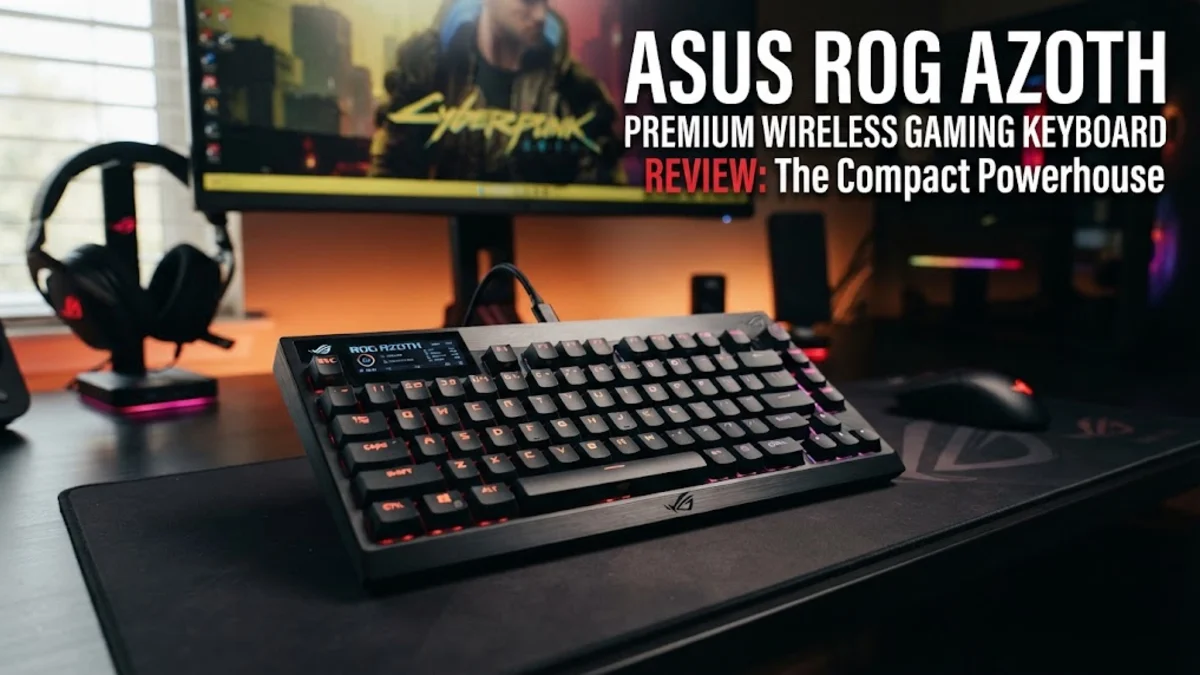
The Asus ROG Azoth directly addresses that divide. Built in a compact 75% form factor, the Azoth combines high-end custom keyboard construction—including a silicone gasket mount, triple-layer foam dampening, factory-lubed mechanical switches, and a bundled DIY switch lubing kit—with high-speed 2.4GHz wireless tech and an integrated 2-inch OLED screen. Verified user feedback and independent lab assessments consistently highlight that Asus managed to deliver custom-grade acoustic feel alongside low-latency wireless gaming performance.
However, entering the custom-grade market comes with a steep price tag. Positioned firmly in the premium peripheral market, the Azoth commands a top-tier retail price. In this review, we examine whether its build quality, battery endurance, and typing acoustics justify the investment for gamers and typists alike.
Design and Build Quality
The Asus ROG Azoth utilizes a 75% layout, retaining dedicated arrow keys and a functional F-row while trimming away the numeric keypad to preserve desk space for mouse movement. The overall chassis feels hefty and sturdy, weighing approximately 1,186 grams (2.61 pounds). The top housing consists of a thick, sandblasted aluminum alloy plate, while the lower shell uses durable plastic to allow clean wireless signal transmission.
Underneath the surface, Asus implemented a gasket-mount system paired with three distinct dampening layers. A thick silicone pad sits beneath the aluminum top plate, followed by PORON foam around the printed circuit board (PCB), and an additional bottom silicone foam layer to eliminate internal case echoing. Reviewers note that this internal structure completely neutralizes the high-pitched pinging noises common in mass-market aluminum and plastic keyboards.
The keycaps are durable PBT doubleshot plastic, offering a subtle textured grip that resists finger oil shine over long gaming sessions. Keycap legends are clear and let per-key RGB backlighting shine through cleanly. On the underside, two-step flip-out feet offer three distinct typing angles. The top-right corner of the keyboard houses the signature 2-inch monochrome OLED display alongside a three-way control knob and side function button.
Key Features and Performance
Every aspect of the ROG Azoth is tuned to balance pure gaming speed with an enjoyable typing experience. Here is how its key systems perform in daily use and high-stakes gaming.
- Switches and Acoustic Tuning: The keyboard features Asus ROG NX mechanical switches, available in Red (linear), Brown (tactile), or Blue (clicky) variants. Stem shafts and base housings come pre-lubricated from the factory, resulting in a smooth keypress with minimal stem wobble. Stabilizers are also factory-lubed and well-tuned, preventing rattling on larger keys like the spacebar and enter key. The PCB is fully hot-swappable, supporting both 3-pin and 5-pin MX-style switches so you can install third-party switches down the road without soldering.
- DIY Switch Lube Kit: Enthusiasts who prefer fine-tuning their switches will appreciate the bundled accessories. Asus includes a switch opener, keycap puller, switch puller, a bottle of Krytox GPL 205g0 lubricant, a small lube brush, and extra switches. Providing genuine Krytox lube in a consumer keyboard package is a rare and welcome touch.
- Tri-Mode Wireless Performance: The Azoth offers three connection modes: low-latency 2.4GHz ROG SpeedNova wireless, Bluetooth 5.1 (allowing seamless pairing with up to three devices), and wired USB-C. In 2.4GHz mode, input latency is virtually indistinguishable from a wired connection, making it suitable for fast-paced competitive esports.
- Battery Endurance: Battery performance is among the best in its class. With RGB lighting and the OLED display turned off, the internal battery lasts up to 2,000+ hours in 2.4GHz mode. Even with full RGB backlighting enabled at moderate brightness, users can expect between 60 and 130 hours of continuous wireless use before needing a USB-C top-up.
- OLED Panel and Control Knob: The 2-inch OLED screen displays system metrics (such as CPU temperature and battery status), active connection profiles, media info, or custom animations. The adjacent three-way toggle switch allows you to quickly adjust volume, switch tracks, alter RGB brightness, or cycle through display modes without opening desktop software.
- Software Management: Device customization relies on Asus Armoury Crate software. While Armoury Crate provides deep control over key remapping, custom macros, Aura Sync RGB lighting, and custom OLED animations, verified owners frequently note that the installer is large and navigation can feel cluttered compared to lightweight configuration tools like QMK or VIA.
Who It Is For (and Who Should Skip It)
Understanding where the ROG Azoth excels helps clarify if it fits your specific setup needs.
- Buy it if: You want the cushioned, quiet typing sound of a custom mechanical keyboard combined with ultra-fast wireless gaming performance. It is ideal for gamers who also type long documents and want hot-swappable flexibility without building a DIY keyboard from scratch.
- Skip it if: You rely heavily on a dedicated numpad for spreadsheet work, prefer light ultra-portable keyboards, or operate on a strict budget. If you prefer open-source web configuration software like QMK/VIA over complex desktop software suites, dedicated custom boards may suit you better.
Alternatives Worth Considering
If you are comparing options in the enthusiast gaming category, consider these alternative models:
Keychron Q1 Max: The Q1 Max features a full CNC aluminum chassis, open-source QMK/VIA web configuration, and exceptional typing feel. However, it lacks an integrated OLED screen and official high-speed gaming wireless suites found on the Azoth.
SteelSeries Apex Pro TKL Wireless: Designed for pure esports performance, the Apex Pro TKL utilizes adjustable magnetic OmniPoint switches, enabling custom actuation points and rapid trigger functionality. However, it lacks hot-swappable switch sockets and custom-tuned acoustic foam dampening.
Razer Huntsman V3 Pro TKL: An analog optical keyboard built for high-level competitive gaming. While its rapid trigger response is top-tier for fast movement in FPS titles, its typing acoustics are noticeably clackier and stiffer than the gasket-mounted Azoth.
Final Verdict
The Asus ROG Azoth successfully proves that a major gaming hardware brand can engineer a keyboard that satisfies custom keyboard hobbyists. By combining a dampened gasket-mount structure, pre-lubed hot-swappable switches, a bundled DIY maintenance kit, and ultra-reliable 2.4GHz wireless tech, it offers one of the best out-of-the-box typing and gaming experiences available today. While the premium price tag and heavy software suite remain notable drawbacks, its construction quality, versatile feature set, and class-leading battery life make it a standout choice for high-end setups.