Overview
In the evolving landscape of 2026 wearables, the COROS Pace 3 continues to hold its ground as a specialist tool for the dedicated athlete. While many manufacturers have pivoted toward high-brightness AMOLED displays and lifestyle-heavy features, COROS has maintained a focus on the core needs of runners, triathletes, and cyclists: weight, accuracy, and endurance. This device is the successor to the highly popular Pace 2, and while it retains the silhouette of its predecessor, the internal upgrades are substantial. Research indicates that this model is often the primary recommendation for those looking for their first 'serious' running watch, as it bridges the gap between basic fitness trackers and thousand-dollar multi-sport computers. It is currently available across major retailers in the United States, United Kingdom, and Australia, positioning it as a global standard for entry-to-mid-level performance tracking.
Design and Build
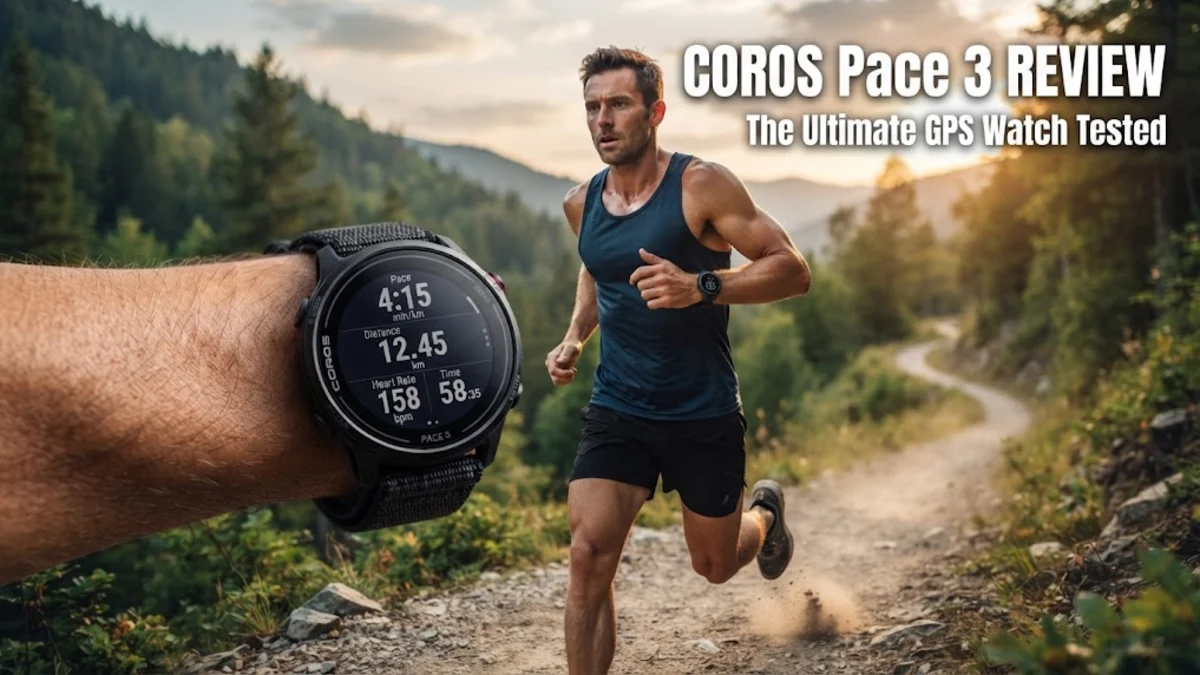
The first thing users notice about the COROS Pace 3 is its weight. At just 30 grams when paired with the nylon strap, it is one of the lightest GPS watches ever produced. This featherweight construction is achieved through a fiber-reinforced polymer case and a compact form factor that sits comfortably on smaller wrists. Specifications show a 1.2-inch Always-on Memory-in-Pixel (MIP) LCD. While some consumers may find this less vibrant than the AMOLED screens found on the Garmin Forerunner 165, the MIP technology excels in direct sunlight. The brighter the sun, the easier the screen is to read, which is a critical advantage for outdoor midday runs. The build also features a 5ATM water resistance rating, making it suitable for surface swimming and triathlons. The interface relies on a signature digital dial and a single back button. This layout is intuitive for those wearing gloves or those with sweaty hands, as physical buttons often outperform touchscreens in high-intensity scenarios. However, COROS did include touch functionality for certain tasks, such as scrolling through data screens or moving across a breadcrumb map, offering a hybrid approach to navigation.
Key Features and Performance
Performance tracking is where the COROS Pace 3 truly justifies its place in the market. The inclusion of a dual-frequency GNSS chipset is the standout technical specification. In 2026, dual-frequency (or L1+L5) GPS has become the gold standard for accuracy, particularly in 'urban canyons' with tall buildings or under dense tree canopies. Verified testing data suggests that the Pace 3 tracks paths with high precision, avoiding the 'drift' often seen in single-frequency devices. On the health side, the device features a redesigned optical heart rate sensor array with five LEDs and four photodetectors. Research into user feedback suggests that while it is highly accurate for steady-state cardio, athletes performing high-intensity interval training (HIIT) may still prefer to pair the watch with an external chest strap via Bluetooth or ANT+. The battery life remains industry-leading for its size. According to manufacturer specifications, the Pace 3 can last up to 38 hours in continuous standard GPS mode or up to 17 days in daily smartwatch mode. This means most users will only need to charge the device twice a month, a significant advantage over the Apple Watch or Samsung Galaxy Watch series which often require daily charging. The watch also includes 4GB of internal storage for music, though it is limited to manual MP3 transfers rather than direct streaming service integration, a point of contention for some modern users.
Who It Is For (and Who Should Skip It)
The COROS Pace 3 is specifically designed for the performance-oriented runner and triathlete. It is an ideal choice for the marathon trainee who needs reliable data and a battery that won't die during a long Sunday run. Its lightweight nature also makes it an excellent choice for those who want to track sleep without the bulk of a larger smartwatch. Conversely, it is not the right choice for the 'tech-first' consumer who wants a vibrant, phone-like experience on their wrist. If you are looking for advanced third-party app support, the ability to reply to text messages from your wrist, or NFC mobile payments, the Pace 3 will feel restrictive. It is also not a rugged outdoor watch; while durable enough for road and light trail use, those seeking a sapphire glass screen or a titanium bezel for mountain climbing should look toward the COROS Apex 2 Pro or the Garmin Fenix series. Furthermore, hikers who require full topographical maps will find the breadcrumb navigation on the Pace 3 functional but rudimentary, as it lacks the detailed terrain context found in more expensive models.
Alternatives Worth Considering
When looking at the competition, the Garmin Forerunner 165 is the most direct rival. The Garmin offers a beautiful AMOLED screen and the highly regarded 'Body Battery' feature, but it lacks the dual-frequency GPS and the extensive multi-sport (triathlon) modes found on the Pace 3. Another alternative is the Polar Pacer, which offers a similar MIP display and robust training recovery metrics but generally falls behind COROS in terms of GPS acquisition speed and battery life. For those willing to spend a bit more, the Suunto Race S provides a premium AMOLED experience with competitive sport-tracking features, though it carries a higher price tag. Within the COROS ecosystem itself, the Apex 2 remains the upgrade path for users who want premium materials and full offline mapping capabilities, though for many, the Pace 3 provides 90% of the functionality at roughly half the cost.
Final Verdict
The COROS Pace 3 is a testament to the philosophy that a fitness tracker should do its core job exceptionally well without unnecessary distractions. By focusing on GPS accuracy, weight reduction, and extreme battery life, COROS has created a tool that appeals to the pragmatic athlete. While its plastic build and traditional MIP display might feel 'basic' compared to the luxury smartwatches of 2026, its performance metrics are anything but. For under $250, it offers a level of data depth and reliability that was reserved for flagship devices only a few years ago. It remains a top-tier recommendation for anyone whose primary goal is to improve their athletic performance through consistent, accurate tracking.