Overview
Home security technology has evolved rapidly, moving away from closed-circuit television systems toward versatile wireless outdoor smart cameras. A major friction point for homeowners remains the ongoing cost of cloud storage subscriptions. The Eufy Security SoloCam S340 addresses this directly by combining high-resolution dual-lens video, full 360-degree pan-and-tilt tracking, and integrated solar charging into a single device with zero monthly fees. By storing video clips directly on internal storage, the camera offers complete privacy and immediate cost savings over subscription-heavy alternatives.
Synthesizing manufacturer data, independent technical reviews, and feedback from hundreds of verified buyers reveals that the SoloCam S340 sits in a sweet spot for home surveillance. It bridges the gap between fixed-view battery cameras and motorized speed domes. Equipped with both a wide-angle 3K main lens and a secondary 2K telephoto lens, the camera can capture wide property coverage while simultaneously zooming in on motion events. In this review, we examine its design, dual-camera video capabilities, solar reliability, smart feature performance, and overall value to help you decide if it fits your home setup.
Design and Build
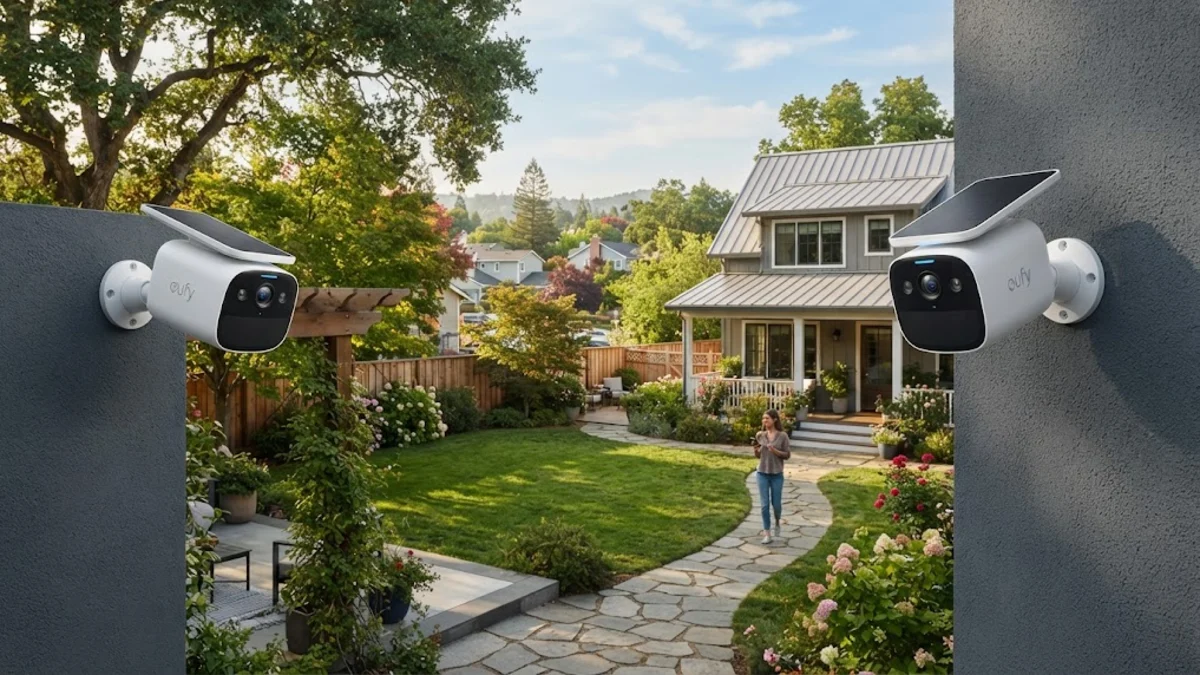
The Eufy SoloCam S340 features a clean, cylindrical white housing constructed from weather-resistant polycarbonate designed to withstand outdoor environments. It carries an official IP65 weather-resistance rating, protecting internal electronics from rain, snow, heat, and direct sunlight. The motorized head rotates horizontally across 360 degrees and tilts vertically up to 70 degrees, allowing a single camera to eliminate blind spots that would typically require multiple fixed units.
A notable design feature is the detachable solar panel. Located on top of the main body by default, the solar module can also be detached and mounted up to 10 feet (3 meters) away using an included extension cable. This structural flexibility is particularly useful for mounting positions situated under deep roof eaves or shaded archways, ensuring the solar panel receives sufficient daily sunlight exposure while keeping the camera head positioned for optimal coverage.
Physical installation requires mounting a single backplate to a wall or wooden post using supplied screws and anchors. Once the bracket is secured, the camera snaps into place. The unit weighs under two pounds, making it solid enough to feel durable without putting excess tension on standard mounting surfaces. The lower optical assembly houses the dual lenses, a motion sensor, standard infrared LEDs, and an integrated 100-lumen spotlight used for color night recording and deterrence.
Key Features and Performance
Video quality is driven by two distinct camera modules working in tandem. The primary sensor captures a wide field of view at 3K resolution (2880 x 1620 pixels), offering sharp detail across open driveways, backyards, or entry paths. The secondary telephoto camera shoots in 2K resolution and offers 3x optical zoom combined with up to 8x digital zoom. When the onboard artificial intelligence detects a person, pet, or vehicle, the camera automatically pans to follow the subject while the telephoto lens zooms in, providing both a broad overview and a detailed close-up of the event.
Reviewers and users consistently highlight the clarity of daytime footage. License plates, facial features, and apparel details remain crisp across varying light conditions thanks to dynamic range processing. At night, the camera defaults to infrared night vision, producing clear black-and-white images. When motion triggers the built-in 100-lumen spotlight, the unit switches to full-color night vision. While the spotlight is modest compared to standalone floodlights, it delivers sufficient light to illuminate targets within 15 to 20 feet.
Power autonomy relies on an internal rechargeable battery supplemented by the solar panel. Under ideal conditions, receiving two hours of direct sunlight per day is sufficient to maintain battery charge indefinitely under standard event-recording frequency. For properties in overcast regions or high-traffic areas where motion triggers occur dozens of times per hour, battery depletion can happen faster than solar replenishing. However, the flexibility to relocate the panel helps mitigate solar placement issues.
Storage handling is another core strength. The camera includes 8GB of built-in eMMC local storage, which typically holds two to three months of historical motion clips based on average daily activity. Recordings are encrypted directly on the device. For users who prefer centralized management or expanded capacity, the SoloCam S340 integrates seamlessly with the optional Eufy HomeBase 3 (S380), enabling expanded storage up to 16TB via an expandable hard drive drive bay, alongside advanced cross-camera AI processing.
Communication and connectivity utilize a standard 2.4GHz Wi-Fi module. Setup is completed via the Eufy Security mobile app, which offers granular control over activity zones, motion sensitivity thresholds, pan speeds, and alert notifications. Dual-way audio allows clear communication through the integrated speaker and microphone, while a manual or automated 90dB siren can be triggered to deter unwanted visitors.
Who It Is For (and Who Should Skip It)
The Eufy SoloCam S340 is ideal for homeowners and renters who want comprehensive outdoor surveillance without recurring monthly costs. Its pan-and-tilt tracking combined with dual lenses makes it exceptionally well suited for monitoring large yards, long driveways, corner lots, or open patio areas where standard fixed cameras miss lateral movement. The solar power capability is a huge bonus for users who want a simple installation without running hardwired electrical cables or dismounting the camera regularly for USB recharging.
However, it is not the right choice for every situation. Because it is battery-powered, the camera operates on event-driven recording rather than 24/7 continuous video capture. Commercial property owners or users requiring uninterrupted round-the-clock video feeds should opt for hardwired Power over Ethernet (PoE) systems instead. Additionally, smart home enthusiasts deeply invested in the Apple HomeKit ecosystem should look elsewhere, as the S340 currently supports Amazon Alexa and Google Assistant, but lacks native HomeKit integration.
Alternatives Worth Considering
When comparing the SoloCam S340 to other popular outdoor cameras, several alternatives stand out based on specific user needs. The Arlo Pro 5S 2K offers superior color accuracy and broader smart home platform support, but it relies heavily on an ongoing Arlo Secure monthly subscription to unlock video history and intelligent motion alerts.
For buyers on a strict budget, the Blink Outdoor 4 provides a lightweight, highly affordable entry point with up to two years of battery life using standard AA lithium batteries. However, the Blink lacks motorized pan-and-tilt motion tracking, dual optical zoom lenses, and built-in solar panels out of the box.
Another direct competitor is the Reolink Argus PT Ultra, which delivers full 4K resolution alongside 360-degree pan-and-tilt capabilities and solar charging. While the Reolink offers expandable microSD card storage, its single-lens design cannot offer simultaneous wide-angle and zoomed-in tracking views like the dual-camera setup on the Eufy S340.
Final Verdict
The Eufy Security SoloCam S340 stands out as one of the most versatile and feature-packed wireless outdoor cameras on the market. By pairing a high-resolution 3K wide-angle lens with a 2K telephoto optical zoom camera and 360-degree motorized tracking, it captures motion events with exceptional clarity. The inclusion of a flexible, detachable solar panel and local encrypted storage solidifies its value, delivering continuous protection with no subscription fees attached. For any homeowner seeking reliable, high-definition outdoor security without long-term maintenance costs, the SoloCam S340 is an outstanding investment.