Overview
In the modern smart home landscape, video doorbells have transitioned from a luxury to an essential component of domestic security. The Eufy Video Doorbell E340 enters this crowded market with a distinct competitive advantage: a dual-camera system designed to eliminate the blind spots common in traditional single-lens devices. While competitors often rely on cloud subscriptions to unlock features like facial recognition or extended history, the E340 emphasizes local storage, appealing to privacy-conscious consumers and those weary of recurring monthly bills. As we evaluate this device, we look at how the E340 balances hardware performance, ease of installation, and smart home integration to provide a comprehensive security solution.
Design and Build
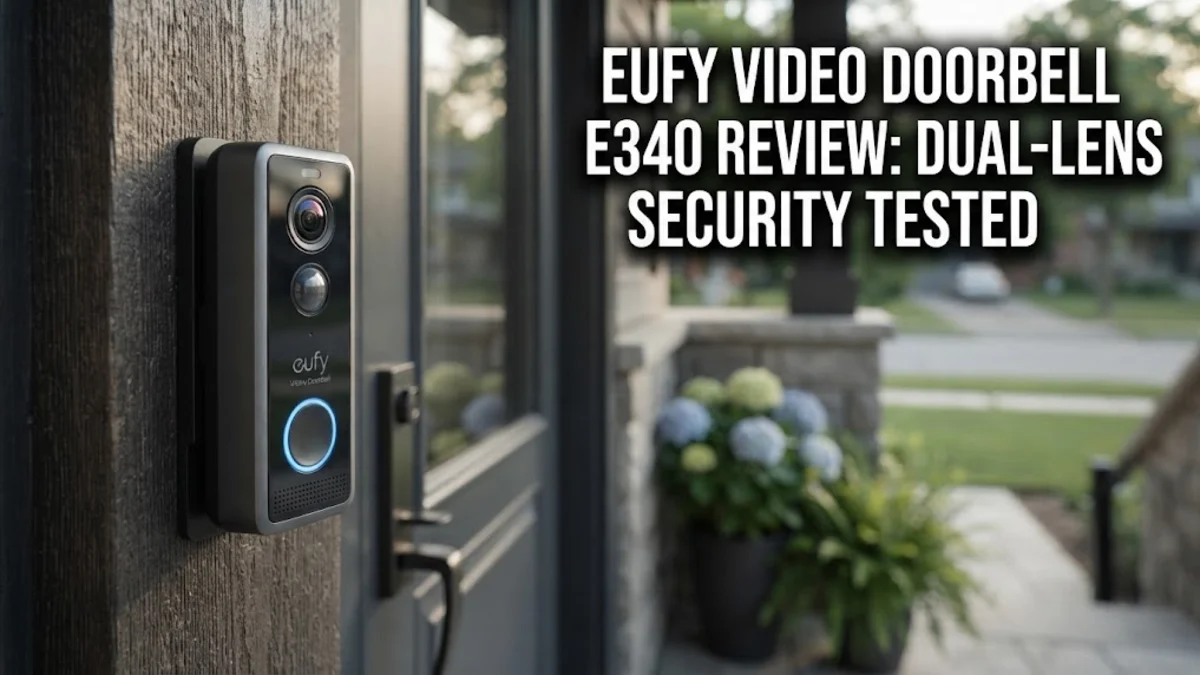
The Eufy Video Doorbell E340 is significantly larger than many of its rivals, a physical necessity required to accommodate the dual-lens array. The device features a clean, utilitarian aesthetic that blends reasonably well into most entryways, though it will certainly be more noticeable than compact competitors. The main front-facing camera handles standard motion and facial recognition, while a downward-facing second camera is specifically engineered to monitor package deliveries. This hardware choice effectively solves the problem of package theft, which has become a primary driver for doorbell camera adoption. The build quality feels robust, designed to withstand rain, snow, and extreme heat, though users should ensure the mounting bracket is secured firmly to handle the extra weight of the device.
Key Features and Performance
The standout feature of the E340 is undeniably its dual-camera functionality. By utilizing two lenses, the doorbell provides a comprehensive view of the porch. When a package is placed near the door, the system automatically detects the delivery, sends an alert, and allows the user to monitor both the visitor's face and the parcel location. This is a significant improvement over single-lens systems that often suffer from distortion or limited vertical field-of-view. The 2K resolution on the front lens provides crisp images, while the downward camera provides sufficient clarity to identify items on the ground. Performance is further bolstered by Eufy's reliance on the HomeBase 3, which acts as the local storage hub. By moving data storage inside the home, users can keep their footage private and easily expandable, avoiding the cloud-dependency that plagues competitors like Ring or Nest. The AI detection capabilities are notably responsive, distinguishing between humans, packages, and stray pets with high accuracy. This reduces the number of false notifications, a common frustration among smart doorbell users.
Installation and Setup
Installation is relatively straightforward, supporting both battery-powered and wired configurations. For those using the battery, the E340 provides a flexible mounting solution, though it does mean the device will periodically need to be removed for charging unless it is hardwired. Eufy includes an angled wedge in the box, which is helpful if your door is perpendicular to the walkway, allowing for a better field of view. Connecting the unit to the HomeBase 3 is a simple, guided process via the Eufy Security app. The app itself is feature-rich, offering extensive customization for motion zones, privacy masking, and notification preferences. However, users should be prepared for the learning curve associated with such a granular control scheme.
Who It Is For (and Who Should Skip It)
The E340 is ideal for the homeowner who prioritizes data privacy and is actively looking to stop package theft. If you live in an area where deliveries are frequent and you dislike the idea of paying a monthly subscription fee for cloud storage, the E340 is arguably the most logical purchase on the market today. It is also well-suited for users who prefer to control their data locally rather than trusting it to a server in a data center.
Conversely, those who live in small apartment complexes may find the E340 to be overkill, both in physical size and functionality. If your primary smart home ecosystem relies heavily on seamless integration with Google Home or Amazon Alexa for complex routines and multi-device interoperability, you may find the E340's integration to be less fluid than that of a dedicated Google Nest or Ring device. Furthermore, if you are not willing to manage a HomeBase 3 unit, the doorbell will not reach its full potential, making it a poor choice for those seeking a standalone, hassle-free plug-and-play experience.
Alternatives Worth Considering
When comparing the E340, it is important to look at what you lose by choosing it over a market leader. The Ring Battery Video Doorbell Pro, for instance, offers superior integration with the broader Amazon Alexa ecosystem and often features more polished app performance. However, you must pay for a Ring Protect subscription to access many of the features that are built into the Eufy's local storage. Similarly, the Google Nest Doorbell is a fantastic device for those already embedded in the Google Home ecosystem, offering stellar facial recognition, but it lacks the dual-camera hardware that makes the E340 so effective at monitoring packages.
Final Verdict
The Eufy Video Doorbell E340 is a powerful, well-engineered solution that targets a specific set of consumer pain points: privacy, recurring costs, and package theft. By providing dual-camera security and a path toward local, subscription-free storage, it delivers genuine value in an increasingly expensive market. While it is physically bulky and demands a specific setup with the HomeBase 3, these trade-offs are justifiable for the peace of mind and financial savings it offers over the life of the product. It is a robust, mature device that proves you do not need a monthly subscription to secure your doorstep effectively.