Overview
Entering the world of dedicated running watches can be overwhelming. There are hundreds of devices on the market, ranging from cheap fitness bands to full-scale training computers. The Garmin Forerunner 55 positions itself as the go-to solution for beginners and casual athletes who want accurate data without needing a degree in sports science. It bridges the gap between basic fitness trackers and high-end multisport watches by prioritizing the metrics runners care about most: distance, pace, heart rate, and training load. Researching current market trends and user feedback reveals that it remains a perennial favorite for its simplicity and the stability of the Garmin Connect ecosystem. Whether you are aiming to finish your first 5K, train for a 10K, or just want to maintain consistency in your weekly mileage, this watch offers exactly what you need without the bloatware often found on modern smartwatches.
Design and Build
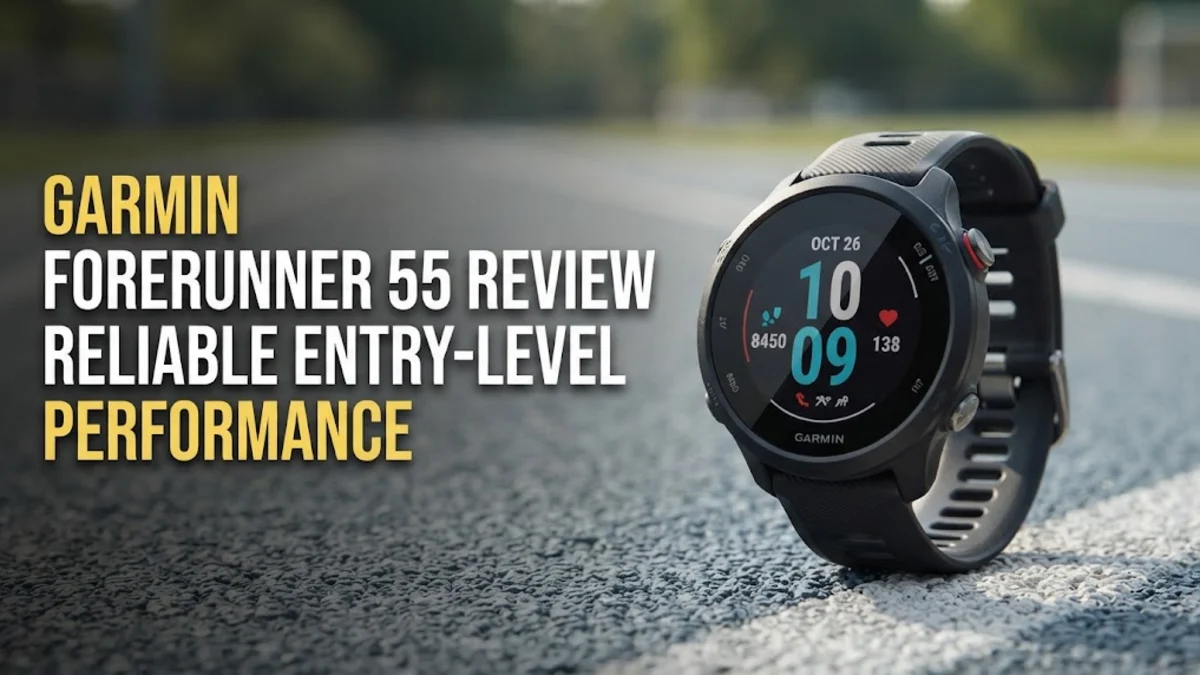
The Forerunner 55 features a lightweight, reinforced polymer casing that feels unobtrusive on the wrist, even during long sessions. At only 37 grams, it is designed to be forgotten until you need it. It utilizes a standard five-button layout, which remains the gold standard for dedicated sports watches. Unlike touchscreens, which can be finicky when your hands are sweaty or wet from rain, these buttons offer tactile, consistent feedback. This is a crucial distinction for runners who operate in all weather conditions. The display is a color transflective memory-in-pixel (MIP) screen. While this type of screen does not provide the deep blacks or high saturation of AMOLED displays, it is exceptionally readable in direct sunlight, which is a major advantage for outdoor activity. You do not need to wake the screen; the data is constantly visible.
Key Features and Performance
The core of the Forerunner 55 is its reliable GPS and heart rate monitoring. The integrated GPS locks onto satellites quickly, providing accurate tracking for outdoor runs, cycling, and walking. Users consistently praise its ability to maintain a signal in forested areas or urban environments where skyscraper interference is common. Beyond raw tracking, the watch includes Garmin's daily suggested workouts. These workouts adapt based on your training history, recovery, and recent performance levels, essentially acting as an automated coach on your wrist. It also includes the PacePro feature in a simplified form, allowing you to manage your effort over different terrains by providing grade-adjusted pace guidance. The wellness features are equally robust, covering stress tracking, body battery energy monitoring, and advanced sleep insights. Battery life is a standout feature for the price point. In smartwatch mode, it can last up to 14 days, and in GPS mode, it typically manages 20 hours of continuous use. This means you do not have to worry about the watch dying in the middle of a long training run, even if you forgot to charge it the night before.
Who It Is For (and Who Should Skip It)
This watch is designed primarily for runners. If you are training for your first race or looking to optimize your performance with structured workouts, the health insights provide tangible benefits that cheaper trackers lack. It is also ideal for those who prioritize reliability, battery life, and high-visibility displays over flashy smart features. You should skip this watch if you are a serious triathlete needing dedicated open-water swimming metrics, or if you require advanced smartwatch capabilities like integrated music storage for Bluetooth streaming, NFC contactless payments, or a vibrant high-resolution display for viewing maps or photos. For those users, the Garmin Forerunner 255 or 965 series are much more suitable, albeit at a significantly higher cost. Additionally, if you work in a professional setting where you need a watch that looks like a high-end jewelry piece, the plastic build might feel too utilitarian for your taste.
Trade-offs and Limitations
Every piece of technology involves compromise. With the Forerunner 55, you are trading premium aesthetics and advanced smart features for functional reliability. The lack of music storage is a notable omission compared to slightly more expensive models. If you enjoy running with music, you will need to carry your smartphone with you. The low-resolution display is also an area where competitors have moved ahead; while it is great outdoors, it does not look as modern as the sharp, vivid screens found on the Fitbit or even some lower-cost fitness trackers. The user interface, while stable, can feel slightly dated compared to the touch-based navigation found on modern smartwatches. You will need to learn the button-press sequences, which, while reliable, have a steeper learning curve than a simple swipe interface.
Alternatives Worth Considering
The COROS Pace 3 is the most direct competitor, often lauded for its slightly more modern interface, longer battery life in GPS mode, and inclusion of features like a barometric altimeter which the Forerunner 55 lacks. If your goal is general wellness rather than dedicated training, the Fitbit Charge 6 offers a more compact, sleek form factor and advanced health sensors at a similar price point. The Amazfit series may appeal to those who prioritize style and display quality, though they often lack the depth of running-specific data analytics that Garmin's ecosystem provides. When comparing these, consider whether you want a "lifestyle" tracker or a "sports" tool; the former focuses on beauty and basic health, while the latter focuses on objective, actionable performance data.
Final Verdict
The Garmin Forerunner 55 succeeds because it does not try to be everything to everyone. It is a focused, durable, and highly effective tool for runners who want to improve. While it lacks some of the flashy sensors and social connectivity of lifestyle-oriented devices, its commitment to providing accurate training metrics at an accessible price point keeps it incredibly relevant in 2026. For the runner who wants to focus on their mileage rather than their tech settings, it remains a difficult watch to beat. It provides the essential building blocks for a healthier, more consistent training lifestyle without requiring a massive financial investment.