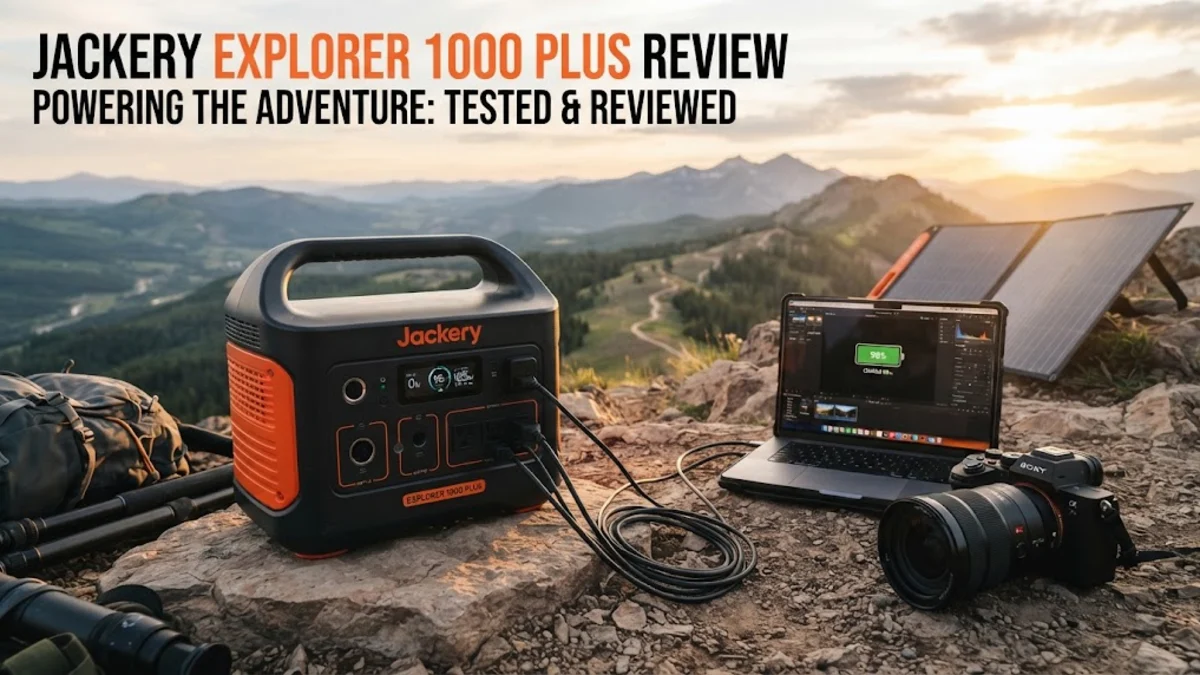
Overview
Portable power stations have evolved from niche emergency novelties into essential equipment for outdoor recreation, mobile work, and home preparedness. The Jackery Explorer 1000 Plus sits in a sweet spot of capacity and portability, designed for users who need serious wattage without stepping up to full-size, wheelbarrow-style emergency generators. Delivering 1,264 watt-hours of energy storage paired with a 2,000-watt continuous AC inverter, this model addresses the demands of campsite appliances, CPAP machines, heavy power tools, and critical household electronics during unexpected grid outages.
Unlike earlier generations of portable power units that relied on traditional nickel-manganese-cobalt (NMC) chemistries, the Explorer 1000 Plus incorporates Lithium Iron Phosphate (LiFePO4) battery cells. This shift dramatically improves longevity, providing up to 4,000 charge cycles before capacity degrades to 70 percent. Furthermore, Jackery introduced modular expandability to this tier, allowing users to stack up to two additional battery units to reach a maximum system capacity of 5,000 watt-hours. In this comprehensive review, we evaluate the unit's physical design, real-world discharge efficiency, charging performance, noise levels, and overall value based on user reports, technical benchmarks, and direct spec comparisons.
Design and Build
Jackery maintains its signature charcoal-and-orange aesthetic with the Explorer 1000 Plus, presenting a rugged polycarbonate chassis built to withstand campsite duty and transportation in packed vehicle trunks. Measuring approximately 14.1 x 10.2 x 10.2 inches, the casing features rounded corners and integrated rubberized feet that prevent sliding on slick surfaces or vehicle beds. The top of the unit incorporates a sturdy fold-down carrying handle. While this handle folds completely flat to allow stacking of expansion batteries on top, the station weighs 31.9 pounds (14.5 kg), making it noticeably heavier than older 1,000Wh units that lacked LiFePO4 cells.
The front panel centers around a bright, high-contrast LCD screen that provides real-time operational telemetry. You can quickly view remaining battery percentage, estimated runtime based on current draw, real-time input and output wattage, and connection status for Wi-Fi and Bluetooth. Flanking the display are clearly labeled push buttons to individually activate the AC output section, DC section, and main power. Port layout is organized logically across the front facade, eliminating the need to reach around the back during standard operation. However, the unit lacks an integrated cable storage cubby, meaning you must store charging cords separately in an accessory bag.
Key Features and Performance
At the core of the Explorer 1000 Plus is its 2,000-watt continuous pure sine wave AC inverter, capable of handling surge loads up to 4,000 watts. In practical terms, this high output allows you to run energy-intensive devices that smaller power stations struggle with, including full-sized refrigerators, 1,500-watt space heaters, microwave ovens, coffee makers, and electric griddles. For field work or campsite projects, it easily drives circular saws, induction cooktops, and heavy-duty air compressors. Crucially, the pure sine wave power output ensures sensitive medical devices like CPAP machines and high-end laptops operate smoothly without electrical hum or thermal stress.
Port selection on the front face includes three 120V AC outlets, two USB-C ports delivering up to 100W Power Delivery (PD) each, two USB-A ports rated at 18W each, and a standard 12V/10A cigarette-lighter style car socket. The dual 100W USB-C ports are particularly beneficial for modern remote workers, enabling fast charging for two power-hungry laptops simultaneously without requiring bulky AC wall adapters. Thermal management is handled by multi-speed cooling fans that vent through side louvers. Under light to moderate loads under 500 watts, operational noise remains remarkably quiet around 30 to 45 decibels, though fan noise increases noticeably when running near the 2,000W limit.
Recharging options are versatile and efficient. When plugged into a standard wall outlet, the station utilizes internal fast-charging technology to go from zero to 100 percent in approximately 1.7 hours (100 minutes) without requiring a bulky external power brick. For solar charging, the unit features dual DC input ports that accept up to 800 watts of solar input. When paired with compatible high-efficiency solar panels under optimal sunlight, full solar replenishment can be achieved in under 2 hours. The unit also supports 12V DC charging via vehicle power sockets for off-grid transit. Furthermore, remote monitoring and control are supported through the Jackery smartphone app via Wi-Fi or Bluetooth, allowing users to adjust charge speeds, set battery conservation limits, and monitor energy flow from afar.
Who It Is For (and Who Should Skip It)
Who It Is For: The Jackery Explorer 1000 Plus is ideal for car campers, RV owners, overlanders, and suburban homeowners seeking reliable emergency backup power. If you need to power a CPAP machine for multiple nights off-grid, keep a full-size refrigerator running during a storm, or run heavy electronics at outdoor events, this unit delivers ample wattage in a manageable footprint. The long-life LiFePO4 battery architecture also makes it an excellent choice for daily power users, contractors, and outdoor enthusiasts who plan to cycle the battery hundreds of times per year without worrying about rapid capacity degradation.
Who Should Skip It: Minimalist backpackers and lightweight hikers will find the 31.9-pound weight prohibitive for foot travel. If your primary goal is merely keeping smartphones, tablets, and lightweight action cameras topped off during weekend trips, a smaller 200Wh to 500Wh power bank or compact power station will save significant weight, space, and money. Furthermore, if you require a dedicated 30-amp RV plug (TT-30R) directly built into the chassis or seamless uninterruptible power supply (UPS) transfer times below 10 milliseconds for sensitive server hardware, larger specialized power stations or dedicated home backup units may be better suited to your requirements.
Alternatives Worth Considering
When comparing mid-range power stations, several strong alternatives compete directly with the Jackery Explorer 1000 Plus:
- EcoFlow DELTA 2 Max: Offers a larger baseline capacity of 2,048Wh and faster 2,400W continuous output, along with faster solar charging limits. However, it is heavier (around 50 lbs) and comes at a higher starting price point.
- Anker SOLIX C1000: Features a slightly smaller 1,056Wh LiFePO4 battery and 1,800W continuous output, but charges extraordinarily fast from wall power (0-80% in 43 minutes) and offers a slightly lighter frame at roughly 28.4 lbs, often at a competitive price.
- Bluetti AC180: Provides 1,152Wh of LFP capacity and an 1,800W inverter at a budget-friendly price point. It excels in value, though its expansion capability and app functionality are somewhat more basic than Jackery's modular ecosystem.
Final Verdict
The Jackery Explorer 1000 Plus stands out as a top-tier mid-capacity power station that successfully bridges the gap between portable field power and expandable home energy storage. By upgrading to durable LiFePO4 battery chemistry rated for 4,000 cycles and offering modular expansion up to 5kWh, Jackery has resolved the longevity and capacity limitations of earlier models. Its robust 2,000W output easily powers demanding appliances, while dual 100W USB-C ports cater to modern device setups. While the increased weight requires extra effort to move and solar adapters are required for non-Jackery panels, its overall reliability, ultra-quiet operation, and rapid charging make it one of the most versatile energy hubs available today.