Overview
In the expansive world of portable power, finding the right balance between weight and capability is a common hurdle for outdoor enthusiasts. The Jackery Explorer 300D enters the market as a refined, entry-level option designed specifically for those who need a reliable, lightweight power source without the bulk of larger units. This station is not meant for powering a campsite's entire kitchen or running high-draw appliances; rather, it occupies the essential niche of the ultra-portable power station. It is a device tailored for weekend campers, remote digital nomads, and families seeking a simple, user-friendly backup solution for keeping their essential mobile devices and small electronics functional during short power outages or off-grid excursions.
By prioritizing a streamlined form factor, the 300D differentiates itself from the behemoths of the industry that require two hands and significant trunk space to transport. Whether you are charging a smartphone in a remote cabin, keeping a laptop powered during a light-duty work stint in the woods, or simply ensuring your navigation gear is ready to go, the Explorer 300D serves as a versatile, low-fuss power utility. Its positioning is clear: ease of use over extreme power, and portability over extended runtime. For the user who prioritizes mobility, this unit represents a compelling trade-off.
Design and Build
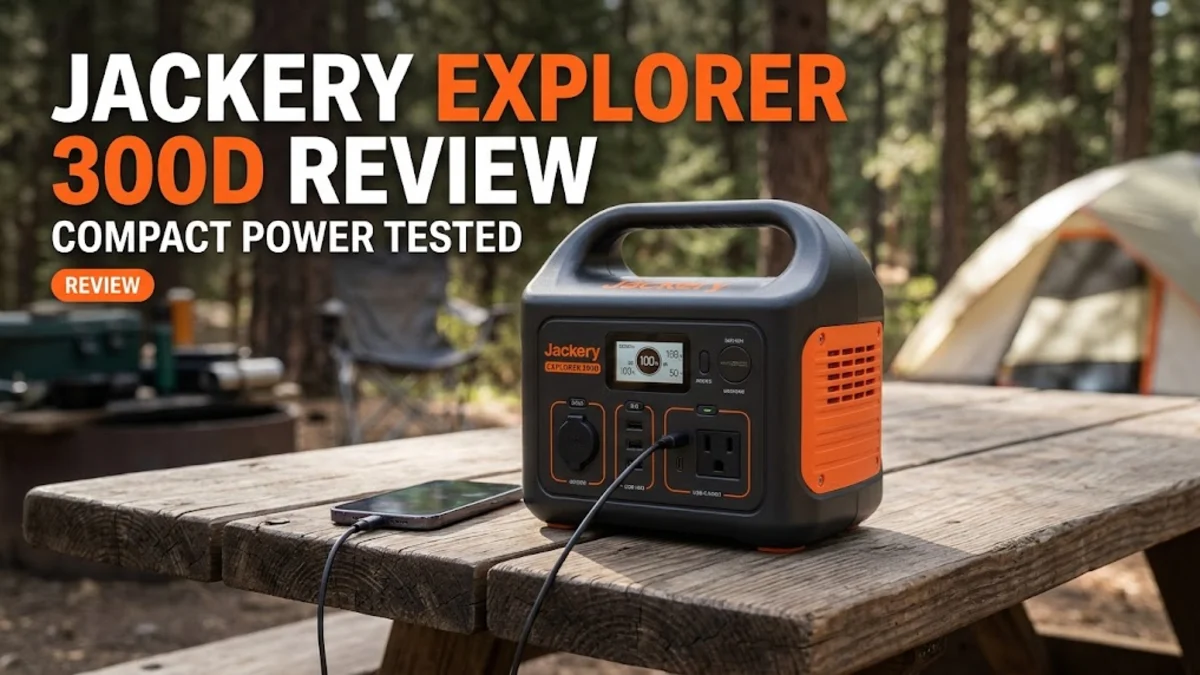
The design philosophy of the Jackery Explorer 300D is centered on rugged utility and intuitive ergonomics. Jackery has maintained its iconic orange and gray aesthetic, which is not merely for branding; the high-visibility orange is a practical feature for locating the device in a dim tent or a cluttered garage. The unit is notably compact, featuring a sturdy, fold-down handle that sits flush with the top of the chassis when not in use. This fold-down mechanism is crucial for storage and stacking, allowing it to fit neatly in the corner of a camping crate or underneath a car seat without wasting precious vertical space.
Beyond its shape, the housing consists of a high-impact polymer that feels denser and more resilient than the entry-level options from many generic competitors. The corner bumpers and textured surfaces are designed to absorb light shocks, which is a common occurrence when moving equipment between vehicles, tents, and storage locations. The thermal management is well-integrated, with discreet ventilation channels that promote airflow without sacrificing structural integrity. The placement of the ports on the front panel is logical, ensuring that even when multiple devices are plugged in, cable management remains straightforward. The screen is protected by a recessed bezel, which helps prevent direct impact on the glass, a common point of failure for many portable power stations in the field.
Key Features and Performance
The performance of the Explorer 300D is defined by its consistency and reliability rather than raw peak power. The front interface is dominated by an easy-to-read LCD screen, a hallmark of the Jackery lineup. This display provides real-time information on input wattage, output wattage, and the current percentage of the battery, which is essential for managing your power consumption accurately. The accuracy of this digital gauge is a significant upgrade over the basic LED light bars found on smaller power banks, providing a tangible sense of how much "runway" you have left before the unit needs a recharge.
- Output Versatility: The unit is equipped with a standard AC outlet, which provides a pure sine wave output. This is vital for users charging sensitive medical equipment or high-end laptops, as it prevents electrical noise that can cause damage or malfunction. You also receive multiple USB-A and USB-C ports, allowing for the simultaneous charging of modern peripherals, phones, and tablets without needing external power bricks.
- Efficient Power Management: The internal battery management system acts as a guardian for your electronics. It effectively handles thermal load, ensuring that if you accidentally draw more power than the unit is rated for, it intelligently manages or shuts down the output to prevent internal cell degradation. This is a critical safety feature that sets it apart from budget-tier power stations that may simply blow a fuse or fail under stress.
- Charging Flexibility: Versatility extends to how you recharge the device. It supports standard AC wall charging, but also features a robust car-charging port, and perhaps most importantly, easy integration with solar panels. During a multi-day trip, the ability to top off the battery via solar during the daytime means you effectively have a renewable source of energy, extending the utility of the device well beyond its internal 300Wh limit.
In practical use, the device excels at what it is designed for: trickle-charging your digital ecosystem. It handles smartphones, tablets, drones, and camera batteries with exceptional efficiency. While it struggles with large resistive heating elements—like portable space heaters or electric kettles—the pure sine wave inverter ensures that the power it does deliver is clean, stable, and safe for your equipment.
Who It Is For (and Who Should Skip It)
This unit is ideally suited for the weekend warrior or the occasional adventurer. If your primary goal is to spend two days in a tent while keeping your phone, headlamp, and drone battery fully charged, the Explorer 300D is likely the perfect capacity. It is also an excellent addition to a home emergency kit. Since it stays light and manageable, even family members who may not be comfortable with large, heavy electronics will find it easy to use during a blackout to keep the Wi-Fi router running or to power a lamp.
However, you should skip this product if you are planning to use high-power appliances. If your intent is to power a portable refrigerator for a week-long off-grid excursion, run a blender, or keep a heavy-duty camping fan running all night, the capacity and wattage of the 300D will simply not suffice. In those scenarios, you would be better served by a larger unit in the 500Wh to 1000Wh range. Furthermore, if your priority is ultra-fast charging to maximize solar harvest in a few hours, you might find that some competitors offer slightly faster input charging profiles than what is seen here.
Alternatives Worth Considering
The marketplace for sub-500Wh power stations is incredibly competitive, which is great for the consumer but challenging for decision-making. The Bluetti EB3A is perhaps the most direct rival. It offers a slightly different feature set, often including a higher peak wattage capacity and sometimes more aggressive charging speeds, which might appeal to those who push their hardware harder. The EcoFlow RIVER 2 is another standout, particularly for users who are obsessed with recharge times. EcoFlow’s proprietary technology often allows for some of the fastest AC-to-battery charging on the market, which is a major advantage if you often forget to charge your gear until the night before a trip. Anker’s 521 model also competes here, focusing heavily on long-term durability and premium cells. Comparing these three is a matter of prioritizing what you value most: Jackery’s proven reliability and ease of use, Bluetti’s feature-to-price ratio, or EcoFlow’s rapid charging speed.
Final Verdict
The Jackery Explorer 300D is a polished, dependable piece of hardware that delivers exactly what it promises: portable, convenient power. It avoids the pitfall of trying to do too much, instead focusing its design on a specific user profile that values portability above all else. It is not an industrial workhorse, but for the average user, the quality of the components, the clarity of the interface, and the ease of transport make it a standout choice. Investing in this unit is an investment in simplicity. It provides enough capacity for the most critical devices without forcing you to compromise on weight, space, or complex setup procedures. For the casual camper or the homeowner preparing for the occasional blackout, this power station hits a perfect equilibrium of price, performance, and durability.