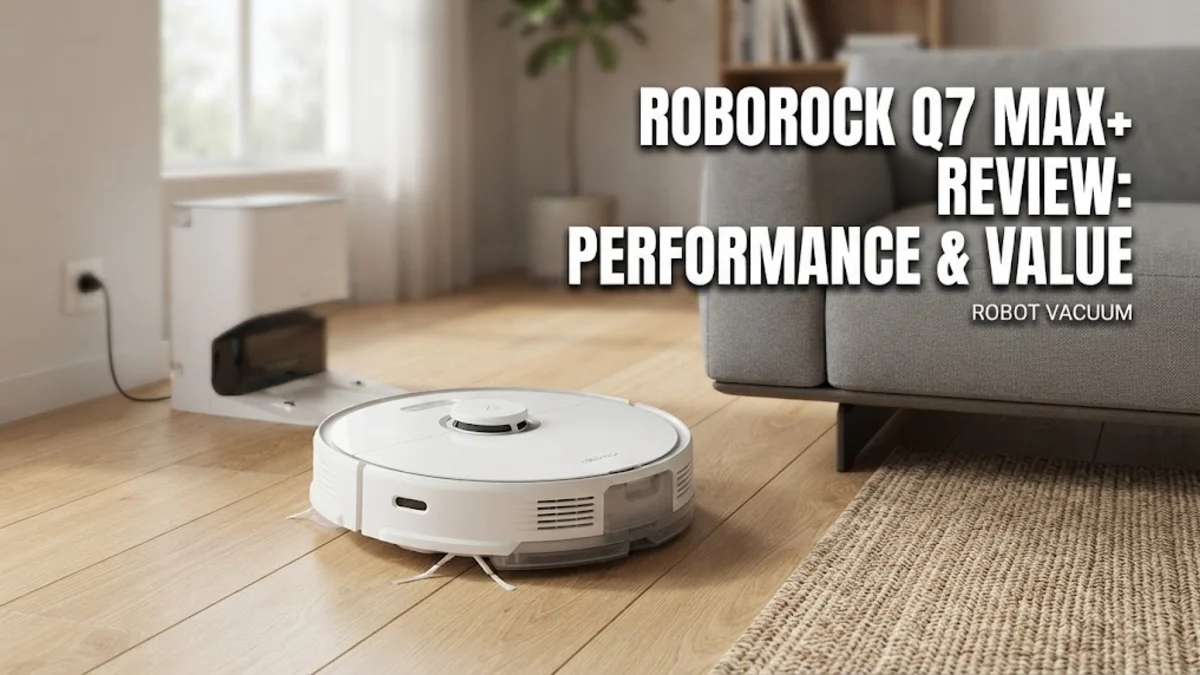
Overview
In the modern smart home ecosystem, the robot vacuum has evolved from a luxury novelty to a staple appliance for time-poor professionals and busy families. The Roborock q7t+ enters this competitive market as a calculated middle-ground offering. It is designed specifically for consumers who have grown tired of the manual labor associated with traditional vacuuming but do not want to spend upwards of a thousand dollars for top-tier features that they might not utilize. By focusing heavily on the fundamentals—suction performance, LiDAR-based navigation, and a reliable self-emptying base station—the q7t+ delivers a consistent cleaning experience that addresses the primary pain points of floor maintenance. Whether you are dealing with hardwood floors, tiled kitchens, or low-pile carpeted bedrooms, this vacuum manages the transition between surfaces with surprising agility.
Design and Build
The Roborock q7t+ follows a design philosophy that favors function and minimalism. The circular body is durable, finished in a matte plastic that resists fingerprints and smudges, which is vital since these devices often live in high-traffic areas. The standout aesthetic element is the raised LiDAR sensor housing, a classic hallmark of precision-navigating robots. Below the hood, the internal dustbin is designed for easy removal, though the inclusion of the self-emptying station means you rarely have to interact with the bin directly. The station itself is compact enough to slide into a closet or sit unobtrusively in a corner, avoiding the bulky footprint found in older generation units. The build quality of the brush assembly and the side brushes suggests a design that can withstand hundreds of cleaning hours before needing significant replacement parts. It feels substantial without being heavy, ensuring it can easily lift itself over door thresholds that can stop less capable robots.
Key Features and Performance
When it comes to performance, the q7t+ excels in logical pathing. Instead of the chaotic bump-and-turn movement seen in entry-level models, this unit uses sophisticated LiDAR sensors to create a high-fidelity map of your home. This mapping process happens quickly upon the first run, allowing the vacuum to clean in neat, parallel lines that maximize efficiency. Once the floor plan is saved, the app opens up a world of control. You can segment rooms, rename them, and dictate specific cleaning intensities for each zone. For instance, you could set the vacuum to run at a lower suction level in the dining room while increasing power in the mudroom where dirt accumulates. The self-emptying dock is the feature most verified buyers appreciate; it uses a high-powered suction system to pull debris from the robot into a sealed bag, effectively reducing the frequency of your personal interaction with the device from daily to monthly. The suction power is consistent even as the bag fills up, preventing the common issue where performance drops as the internal bin approaches capacity. While it does not claim to compete with industrial-grade upright vacuums, its ability to keep daily dust, allergens, and pet hair in check is highly competitive for its class. The edge-sweeping brush is also worth noting, as it effectively guides debris from corners into the main suction pathway, which is often a point of failure for cheaper circular designs.
Who It Is For (and Who Should Skip It)
This vacuum is a perfect fit for the "set it and forget it" lifestyle. If your home has a relatively consistent layout and you value the convenience of not having to touch a vacuum bin for several weeks at a time, the q7t+ provides exceptional value. It is particularly well-suited for families with pets, as the combination of high suction and a sealed dust-disposal system ensures hair and dander are removed without being scattered back into the air. However, there are specific scenarios where this model might fall short. If you live in a house with severe clutter, such as exposed electrical cables, toys, or loose socks scattered regularly on the floor, the q7t+ may struggle. Unlike models with front-facing camera AI that can identify and label specific obstacles, the q7t+ relies on proximity sensing. It will gently touch furniture rather than avoiding it entirely. Furthermore, if you are looking for a hybrid device that performs industrial-grade mopping to remove stuck-on stains, the q7t+ may feel a bit limited. Its mopping capability is better described as a damp wipe; it is perfect for dust collection, but not for heavy-duty floor polishing or deep cleaning.
Alternatives Worth Considering
The marketplace for robot vacuums is vast, and knowing your alternatives is key. The iRobot Roomba j7+ remains the primary benchmark in this space, especially if obstacle avoidance is your highest priority. The Roomba’s front-facing camera-based AI is adept at navigating around pet waste and small objects, which makes it a safer bet for chaotic households. However, you pay a significant premium for that technology. On the other end of the spectrum, the Eufy L60 offers a very strong cleaning performance for a significantly lower price. The trade-off is the lack of a self-emptying base station, meaning you will return to the daily chore of manually clearing the internal bin. For those who want a similar user experience to the q7t+ with a slightly different maintenance focus, the Ecovacs Deebot N20 provides an alternative with a robust app experience, though users often note that the mapping interface is not quite as intuitive as the Roborock system. Choosing between these comes down to your personal hierarchy of needs: do you prioritize autonomous maintenance, superior obstacle avoidance, or the absolute lowest entry price?
Final Verdict
Ultimately, the Roborock q7t+ succeeds because it avoids the feature bloat that often drives up costs and lowers reliability. By focusing on what truly matters—a clear path, effective debris suction, and a hands-off disposal system—it fulfills its promise to the end user. It is a highly capable, mid-range performer that thrives in homes that are reasonably organized. While it lacks the advanced camera-based obstacle avoidance of its much more expensive rivals, its consistent performance and reliable software make it a winner. It is a smart, efficient investment that will significantly reduce the amount of time you spend on household chores, letting you focus your energy on what you enjoy instead of floor maintenance. For most shoppers in the current market, it hits that elusive 'sweet spot' of price, capability, and longevity, making it a highly recommended choice for a wide range of living situations.