Overview
In an era where high-bitrate 4K and 8K video footage, massive photo libraries, and sprawling game installs demand rapid external storage, portable solid-state drives have become indispensable tools for content creators, field photographers, and tech enthusiasts. Samsung has long held a dominant position in the external storage market with its popular T-series line, spanning iconic models like the classic T5 and the rugged T7 Shield. With the Samsung T9 Portable SSD, the manufacturer addresses the growing demand for higher throughput by upgrading the interface to USB 3.2 Gen 2x2, effectively doubling theoretical transfer rates up to 2,000 MB/s compared to previous 10Gbps models.
Our review synthesizes verified technical specifications, independent performance benchmarks from hardware specialists, and feedback patterns from verified long-term users to provide an authoritative evaluation of the Samsung T9. While it retains the compact footprint and drop resistance buyers expect from Samsung portable storage, its real-world performance depends heavily on host hardware compatibility. Below, we break down its design, transfer speeds, thermal management, software ecosystem, and overall value to help you decide if this high-speed drive fits your workflow.
Design and Build Quality
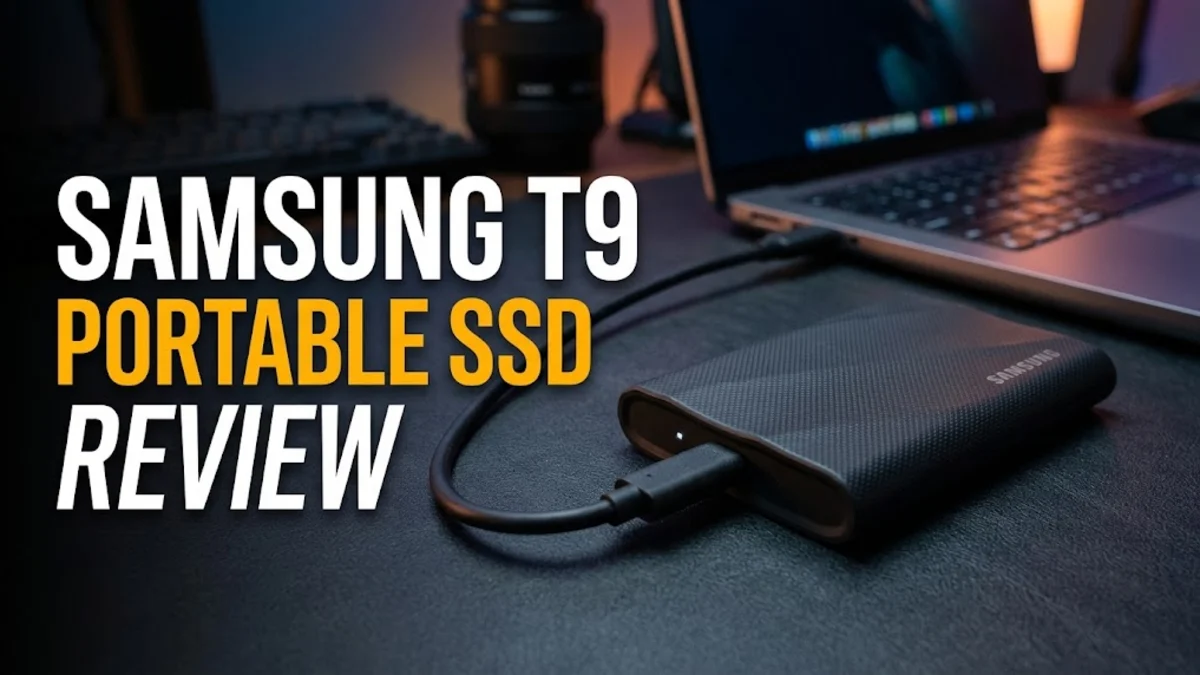
The Samsung T9 departs slightly from the smooth aluminum shells of earlier drives like the standard T7, taking clear design inspiration from the ruggedized T7 Shield. The outer shell consists of an aluminum core wrapped in a tactile, carbon-patterned silicone rubber exterior. This curved, textured jacket provides a comfortable, slip-resistant grip when working on location or handling the drive with wet or gloved hands, while also buffering the internal drive architecture against everyday bumps and drops.
Measuring 88 x 60 x 14 mm and weighing approximately 122 grams (4.3 ounces), the T9 is roughly the size of a stack of credit cards. It is slightly thicker and heavier than ultra-slim alternatives like the Kingston XS2000 or Crucial X9, but it remains remarkably portable and easily slips into a camera bag pocket, laptop sleeve, or jacket pocket. Samsung rates the drive for drop resistance from heights up to 3 meters (9.8 feet), providing peace of mind when transporting critical client files or media archives on travel assignments.
However, users should take note of a key design trade-off: unlike the Samsung T7 Shield, the T9 does not carry an official IP rating for water or dust resistance. While the rubberized outer skin shields the metallic chassis from physical impacts and scuffs, the exposed USB-C port lacks a protective flap or internal sealing against water submersions and heavy dust ingress. If your field work frequently involves rainy environments, sandy beaches, or harsh outdoor environments, this lack of environmental weather sealing is an important factor to weigh.
In the box, Samsung includes two robust, high-quality connectivity cables: a USB Type-C to Type-C cable and a USB Type-C to Type-A cable. Both cables are thick, durable, and specifically wired to support full USB 3.2 Gen 2x2 20Gbps bandwidth. Providing both cable options ensures seamless connection to modern laptops, desktop PCs, older legacy computer ports, tablets, and smartphone devices without needing third-party adapters or dongles.
Key Features and Performance
The core selling point of the Samsung T9 is its USB 3.2 Gen 2x2 interface, which enables theoretical maximum sequential read and write speeds up to 2,000 MB/s. In independent laboratory testing on systems equipped with native 20Gbps USB host controllers, the drive achieves impressive real-world results, topping out at approximately 1,950 MB/s sequential read and 1,910 MB/s sequential write. Transferring a 50GB batch of raw video files or a heavy game folder takes under thirty seconds under ideal conditions.
Sustained write performance is another area where the T9 shows clear strengths over budget portable SSDs. Many portable drives utilize small dynamic SLC caching buffers that degrade to sluggish write speeds once the cache is filled during long, uninterrupted write tasks. Thanks to Samsung's upgraded Dynamic Thermal Guard and optimized TurboWrite software algorithms, the T9 maintains high write throughput across large file transfers, making it well-suited for transferring multi-hundred-gigabyte video projects or continuous media backups without severe performance dips.
A critical technical caveat for potential buyers is host interface compatibility. USB 3.2 Gen 2x2 relies on dual-lane 10Gbps data transmission, requiring specific motherboard hardware support. Standard Thunderbolt 3, Thunderbolt 4, and standard USB4 ports on Apple Mac computers (including current M-series MacBooks and Mac Studio desktop machines) do not support the Gen 2x2 dual-lane standard. When connected to a Mac or standard 10Gbps USB-C port, the Samsung T9 automatically operates in backward-compatible USB 3.2 Gen 2 mode, capping read and write speeds at roughly 1,000 MB/s. While 1,000 MB/s remains plenty fast for general file editing, Mac users cannot unlock the drive's advertised 2,000 MB/s peak speed.
For mobile content creators using recent iPhone 15 Pro, iPhone 16 Pro, or iPad Pro devices with USB-C ports, the T9 functions smoothly as an external recording drive. Videographers can capture high-bitrate Apple ProRes 4K video at 60 frames per second directly to the drive without dropping frames, provided the drive is formatted properly in exFAT or APFS. Furthermore, gamers can attach the T9 to modern consoles like the PlayStation 5 or Xbox Series X as fast external storage for playing legacy titles or storing current-generation games.
To prevent performance degradation caused by heat buildup, Samsung incorporates Dynamic Thermal Guard technology. During extended 2,000 MB/s write sessions, high-speed controller components generate significant heat. Testing indicates that while the exterior rubber casing becomes noticeably warm during heavy workloads, the internal thermal management spreads heat efficiently across the casing, keeping drive temperatures within safe limits and preventing sudden thermal throttling slowdowns.
On the security and utility front, the T9 features AES 256-bit hardware encryption. Using the downloadable Samsung Magician software suite—compatible with Windows, macOS, and Android—users can toggle password protection, update drive firmware, monitor drive health metrics, run performance benchmarks, and authenticate genuine Samsung hardware. The software interface is clean, intuitive, and offers valuable tools for maintaining long-term drive reliability.
Who It Is For (and Who Should Skip It)
The Samsung T9 is ideally tailored for PC power users, Windows workstation operators, digital imaging technicians, and creative professionals whose computers feature native USB 3.2 Gen 2x2 motherboard ports. If you regularly move multi-gigabyte video files, manage huge raw photo libraries, or work with heavy virtual instruments, the T9 delivers exceptional speed and sustained write stability that noticeably reduces workflow bottleneck times.
On the other hand, Apple Mac users should evaluate their purchasing decision carefully. Because current macOS hardware does not support the USB 3.2 Gen 2x2 protocol, Mac users will experience performance limited to 1,000 MB/s—performance identical to the significantly cheaper Samsung T7 or T7 Shield. Additionally, outdoor videographers working in wet or muddy outdoor locations who require certified dust and water ingress protection may prefer an IP65-rated drive like the Samsung T7 Shield or SanDisk Extreme Pro V2.
Alternatives Worth Considering
Before purchasing the Samsung T9, it is worth comparing it against top-rated competing models in the high-speed external storage market:
- Crucial X10 Pro: An ultra-compact drive that also features a USB 3.2 Gen 2x2 interface, reaching speeds up to 2,100 MB/s. The X10 Pro includes IP55 water and dust resistance in a tiny aluminum body, making it lighter and more rugged for field travel, though its internal cache management is slightly less consistent on multi-hundred-gigabyte transfers compared to the T9.
- SanDisk Extreme Pro Portable SSD V2: Delivering up to 2,000 MB/s speeds via USB 3.2 Gen 2x2, this drive features an integrated carabiner loop and IP65 weather resistance. However, it commands a higher price tag and has historically faced scrutiny over firmware stability in earlier production batches.
- Samsung T7 Shield: If your laptop or workstation only supports standard 10Gbps USB connections, the T7 Shield is a smarter purchase. It offers transfer rates up to 1,050 MB/s, full IP65 water and dust resistance, and identical drop durability at a much lower cost per gigabyte.
Final Verdict
The Samsung T9 Portable SSD is a well-built, high-performing external solid-state drive that successfully delivers on its promise of 2,000 MB/s speeds for users equipped with compatible USB 3.2 Gen 2x2 hardware. Its comfortable rubberized outer casing, effective thermal management, solid sustained write speeds, and comprehensive Samsung Magician software package make it a standout choice for high-volume content creation and PC power users. Although the lack of an official IP weather rating and limited support for 20Gbps USB speeds on Apple Mac computers prevent it from being a universal pick, it stands as one of the fastest and most dependable portable USB drives available today.