Overview
The Jackery Explorer 500 has firmly established itself as a foundational product in the consumer portable power market. For years, outdoor enthusiasts, tailgaters, and emergency-minded homeowners have turned to this specific model as a reliable bridge between ultra-small power banks and massive, heavy home backup generators. Researching current expert roundups and verified buyer patterns reveals that the Explorer 500 maintains its strong market presence not because it boasts cutting-edge specifications, but because of its enduring reputation for straightforward reliability. It occupies a distinct niche for users who prioritize simplicity, portability, and trust over raw technical innovation. As the market shifts heavily toward LiFePO4 chemistry and rapid-charge systems, understanding how the Jackery Explorer 500 holds up today requires a close look at its real-world performance, physical design trade-offs, and how it stacks up against modern alternatives.
Design and Build
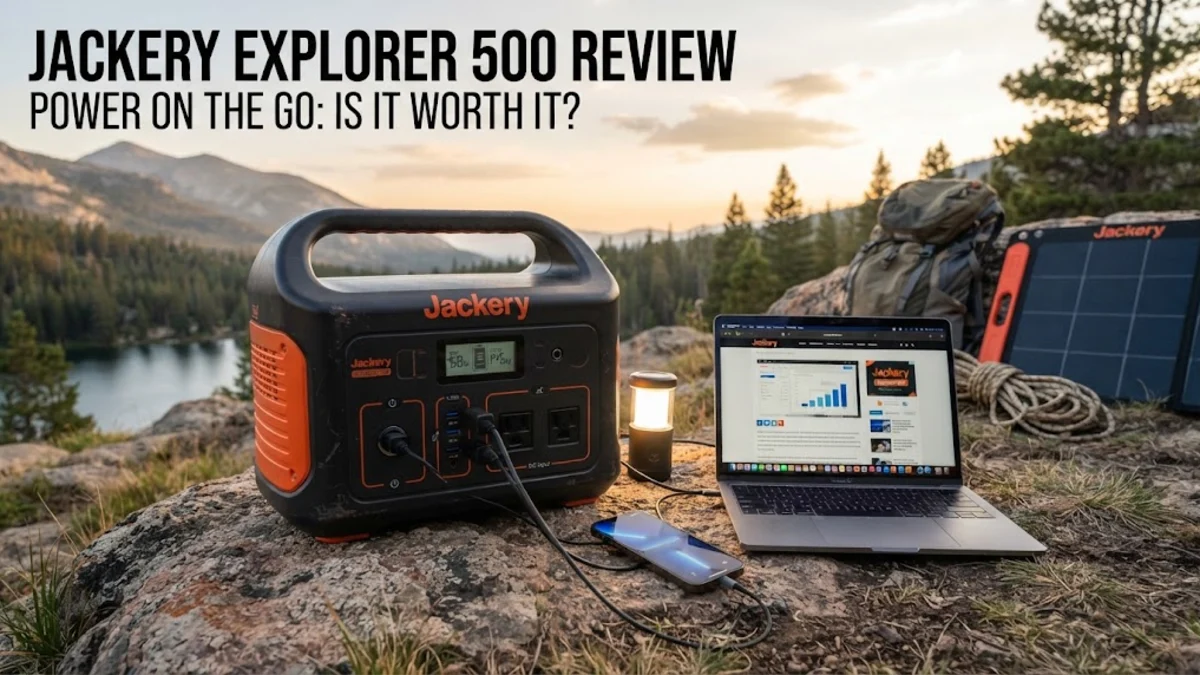
Weighing in at precisely 13.3 pounds, the Jackery Explorer 500 strikes an impressive balance between internal energy capacity and physical transportability. Lifting it out of a car trunk or carrying it from a campsite parking area to a tent site does not require significant physical effort, largely thanks to the sturdy, fold-flat plastic handle integrated smoothly into the top housing. The enclosure utilizes a durable orange and black polycarbonate shell designed to handle the minor bumps and scrapes typical of outdoor recreation. The front control board is logically laid out, separating the AC output, DC carport, USB ports, and the main power buttons into clearly demarcated zones. The built-in LCD screen serves as the operational dashboard, displaying current battery percentage, input charging wattage, and total output wattage. While it lacks Bluetooth or Wi-Fi companion app integration—features becoming common in newer competitors—the physical interface is entirely intuitive, making it accessible to users of all tech literacy levels.
Key Features and Performance
At its core, the Explorer 500 houses a 518Wh lithium-ion NMC battery pack paired with a 500-watt pure sine wave inverter capable of handling 1000-watt surge peaks. This combination allows it to safely power a wide array of sensitive electronics, including laptops, camera battery chargers, CPAP medical devices, LED string lights, and small portable refrigerators. In practice, the pure sine wave output ensures that sensitive microprocessors in modern laptops and medical gear receive clean, stable electricity without risk of electrical interference or damage. However, performance analysis reveals clear boundaries. Because the inverter maxes out at 500 watts, attempting to plug in high-draw heating appliances like coffee makers, hair dryers, or electric kettles will immediately trigger the overload protection and shut down the unit. Recharging the unit is versatile but historically slow by modern standards. Using a standard wall outlet takes roughly 7.5 hours, while car charging takes about 8 hours. When paired with compatible 100W solar panels in optimal sunlight conditions, a full recharge generally requires between 7 and 8 hours. One critical consideration in long-term performance is the battery chemistry: the internal lithium-ion cells are rated for approximately 500 charge cycles before degrading to 80 percent of their original capacity, which falls well short of the 3000-plus cycles offered by modern LiFePO4 alternatives.
Who It Is For (and Who Should Skip It)
Determining whether the Jackery Explorer 500 fits your lifestyle depends entirely on your power demands and usage frequency. This power station is ideal for casual weekend campers who need to keep smartphones, headlamps, and drone batteries charged over a two-night trip without access to grid power. It is equally valuable for remote workers who occasionally need an emergency office power source during brief blackouts, as well as CPAP users who require a dependable overnight medical backup during mild weather emergencies. Conversely, you should skip this model if you are planning extended off-grid living, van life conversions, or heavy-duty outdoor excursions where appliances drawing over 500 watts are necessary. Furthermore, if you plan to use a power station daily or cycle it frequently, the limited 500-cycle lifespan of its lithium-ion battery means it will degrade much faster than newer LiFePO4 units, making those options a smarter long-term investment.
Alternatives Worth Considering
The portable power station market has evolved rapidly, introducing several strong competitors that challenge the Jackery Explorer 500 in price, longevity, and feature sets. The EcoFlow RIVER 2 Pro is a primary rival, offering a larger 768Wh capacity and a much higher 800W output while utilizing advanced LiFePO4 battery chemistry for thousands of cycles, all within a similarly portable weight class. Another compelling option is the Bluetti EB55, which matches a 537Wh capacity with a 700W inverter, LiFePO4 cells, and dual AC outlets, addressing one of Jackery's main hardware limitations. For users whose power needs have outgrown mid-tier stations entirely, the Anker SOLIX C1000 provides massive capacity, blistering fast recharge speeds, and robust output capabilities, though it introduces a noticeable increase in physical weight and financial cost.
Final Verdict
The Jackery Explorer 500 remains a respected, highly functional product in a crowded marketplace primarily because it excels at what it was designed to do: deliver uncomplicated, safe, and portable electricity for light-to-moderate use cases. While it undeniably trails behind newer market entrants in terms of battery longevity, recharge speeds, and output wattage, its legendary reliability and ease of use continue to resonate with everyday consumers. If you view a power station as a simple, occasional tool for weekend adventures or basic home emergency readiness, the Explorer 500 remains a dependable companion that delivers on its core promises without unnecessary technological complexity.