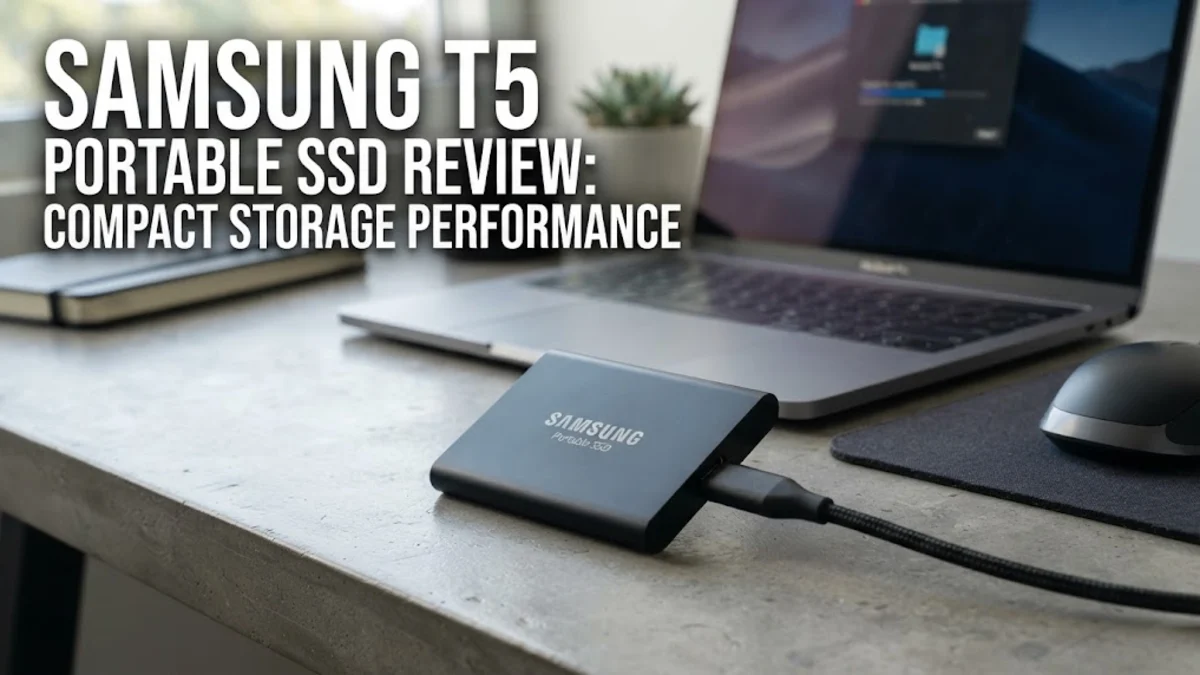
Overview
In the evolving landscape of external storage, the Samsung T5 has carved out a permanent legacy as a benchmark for portable solid-state drive (SSD) performance and design. When it first entered the market, it disrupted the dominance of bulky, slow mechanical external hard drives by introducing a streamlined, flash-based storage solution that was small enough to fit inside a pocket. Even as we enter late 2026, with newer, higher-speed NVMe drives becoming common, the T5 maintains its status as a reliable workhorse. It is a device built for the pragmatic user who values consistency over bleeding-edge benchmarks.
The T5 is designed to bridge the gap between high-capacity, slow storage and high-speed internal drive performance. By utilizing the USB 3.1 Gen 2 interface, the drive offers speeds that are vastly superior to traditional spinning disk drives, which are prone to failure if dropped or moved while spinning. Because the T5 features no moving parts, it is inherently more resilient, making it an excellent choice for professionals who move between home offices, client sites, and remote locations. It is this balance of physical ruggedness and respectable speed that has made it a staple in the gear bags of photographers, videographers, and students across the globe.
Design and Build
The aesthetic of the Samsung T5 is one of its most defining characteristics. Measuring approximately 74mm by 57mm by 10mm, the drive is incredibly unobtrusive. The chassis is constructed from a robust, brushed metal, which serves two primary purposes: it acts as a heat sink to dissipate the warmth generated during heavy data transfers, and it provides a structural layer of protection against accidental drops and pressure. In testing environments, this metal casing has been shown to withstand drops from significant heights without compromising the internal integrity of the storage controller.
The minimalist design philosophy is evident throughout the unit. There are no power switches to toggle or batteries to manage; it draws power directly from the connected host device via a single USB-C port. A small, subtle blue LED indicator provides visual feedback when the drive is active, indicating power and file transfer progress without being overly bright or distracting in a dark room. The weight is negligible, coming in at just over 50 grams, which means it will not add noticeable bulk to a laptop bag or camera kit. This compact nature is particularly appreciated by digital nomads who need to maintain a light travel weight while still having access to terabytes of data.
Key Features and Performance
When discussing performance, it is important to understand what the Samsung T5 achieves. With sequential read and write speeds hovering around the 540MB/s mark, it is more than fast enough for most professional workflows that do not involve 8K RAW video editing. For the average user, this means that transferring a 10GB folder of high-resolution images or a large document library takes only seconds rather than minutes. The drive uses the V-NAND flash technology that Samsung is world-famous for, which ensures that read and write operations are stable and predictable over long periods of heavy usage.
Security is another pillar of the T5 experience. The device ships with software that enables AES 256-bit hardware encryption, a robust security standard that ensures your data remains inaccessible even if the drive is physically lost or stolen. This is a critical feature for business users carrying sensitive client data or confidential project files. The setup process for this encryption is straightforward, requiring the user to set a password through the included management software. Once enabled, the drive requires this password every time it is plugged into a computer, providing peace of mind in high-security environments.
Furthermore, the compatibility of the T5 is a significant advantage. Because it supports both USB-C and USB-A (via the included cables), it works seamlessly with older desktop workstations, modern thin-and-light laptops, and even recent smartphones and tablets. For creative professionals, this means being able to edit footage directly from the drive on a MacBook Pro or transferring photos from a mirrorless camera to an Android tablet in the field. The software also provides convenient firmware updates, ensuring the drive remains optimized as operating systems evolve.
Who It Is For (and Who Should Skip It)
The T5 is perfectly suited for those who need a reliable, "it just works" storage solution. Students find it invaluable for keeping entire semesters of research and assignments in one place. Photographers benefit from the fast ingest speeds, allowing them to clear memory cards quickly during shoots. Even for general home users who want to back up their family photos and important documents, the T5 offers a much higher level of protection than cloud storage alone, as it keeps your data in your physical possession without ongoing subscription costs.
However, you should consider skipping the T5 if you are an power user engaged in tasks that demand maximum throughput. If your workflow involves constant 4K/60fps video rendering, heavy color grading on large-format media, or massive database work where every millisecond counts, you should look toward newer NVMe drives that utilize USB 3.2 Gen 2x2 or Thunderbolt interfaces. These modern drives can double or triple the speed of the T5. Additionally, if you frequently work in extreme outdoor environments where the device might be subjected to heavy rain, mud, or extreme grit, you might prefer a drive that carries an official IP67 or IP68 rating, as the T5 is not explicitly water-resistant.
Alternatives Worth Considering
Comparing the T5 to its peers reveals a crowded market. The Samsung T7 is the natural successor to the T5, offering double the transfer speeds for those who need a performance boost. If you are a fan of Samsung's software and reliable hardware design, the T7 is the logical next step. For users seeking a more "rugged" profile, the SanDisk Extreme Portable SSD is an excellent competitor. It features a rubberized exterior that is designed to survive drops and light splashes, making it a favorite for adventure photographers and hikers. Finally, the Crucial X6 offers a similarly compact footprint and is often found at a highly competitive price point. It represents a fantastic value for those who want an SSD but are working within a tighter budget.
Final Verdict
In the current technological climate of 2026, the Samsung T5 stands as an excellent example of long-term product value. It successfully balances the demands of performance, portability, and build quality. While it is not the fastest drive on the market, its speed remains remarkably relevant for the majority of users, and its reliability is well-documented by years of positive feedback. Investing in a T5 is about choosing a proven device that protects your data with hardware-level security while providing enough speed to ensure that your workflow is never unnecessarily slowed down. For anyone looking for a dependable portable SSD that won't fail, the T5 is a benchmark for a reason.